Episode 2: The Definition of Medical Device "Clinical Evaluation"
How to Take the Exam?
Last time we discussed the origin of medical device "clinical evaluation." So the question arises: what exactly is "clinical evaluation"? Is this "performance and safety exam" testing theory or practical operation? How should one prepare for it? We need to explain this step by step.
This time, let's first look at the definition of "clinical evaluation," as Confucius said, "If names are not correct, language will not be in accordance with the truth of things."
Definitions of Clinical Evaluation by Different Authorities
NMPA Definition:
A continuous activity of analyzing and evaluating clinical data using scientific and reasonable methods to confirm the safety, clinical performance, and/or effectiveness of a medical device within its scope of application. (Translated from Chinese)
MDR Definition:
A systematic and planned process to continuously generate, collect, analyse and assess the clinical data pertaining to a device in order to verify the safety and performance, including clinical benefits, of the device when used as intended by the manufacturer.
IMDRF Definition:
A set of ongoing activities that use scientifically sound methods for the assessment and analysis of clinical data to verify the safety, clinical performance and/or effectiveness of the device when used as intended by the manufacturer.
These three definitions seem similar; all aim to confirm the safety, clinical performance, and/or effectiveness (clinical benefits) of a medical device within its scope of application. NMPA's regulatory science system has borrowed from IMDRF's international harmonization achievements; both focus on "evaluating using existing data," and there is no substantial difference. However, there are subtle differences in the details of the definitions between NMPA/IMDRF and MDR. Regulatory documents are the result of repeated deliberation, especially the definitions of core terms, which require careful study. The differences in details reveal subtle differences in perspective and focus, directly determining the "tightness" and "rules of the game" of regulation.
An Analogy
Suppose you are a restaurant owner (manufacturer), and your "dishes" are medical devices. Now, you need to prove that your dishes are "safe and delicious" according to the rules of different "food review agencies" (regulatory authorities).
I. The "Food Review Philosophies" of Different Agencies
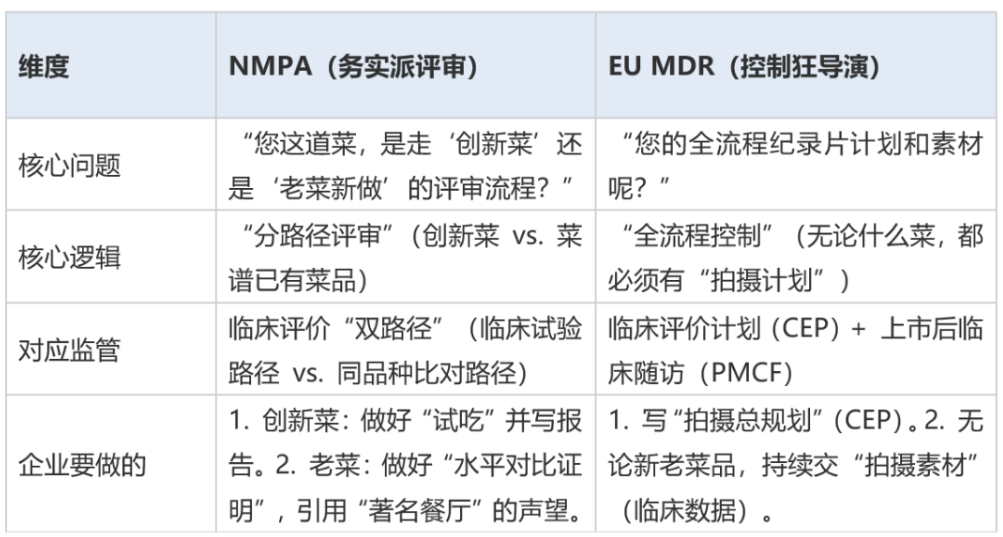
01 Benchmarking NMPA / China: The Pragmatic Reviewer
Core Rule: We divide dishes into innovative dishes and dishes already in the recipe book.
Innovative Dishes: You (the manufacturer) must organize new guests to taste the food and submit a complete tasting report (clinical trial report) to prove the safety and deliciousness of its unique flavor.
Dishes Already in the Recipe Book: No need to make new guests eat it again. You only need to prove that your cooking level reaches the level of a famous restaurant's signature dish. The method is: compare ingredients, heat, and procedures in detail (equivalence demonstration), and provide customer praise and historical food reviews of that famous restaurant (clinical literature/data of equivalent devices) to indirectly prove it.
Role: A pragmatic food reviewer who values results and manages by category.
Focus: Which path are you taking? Does the evidence match?
Subtext: I won't use a one-size-fits-all approach. For new dishes, submit a new report; for old dishes, take the "copy homework" path. But the key to "copying homework" is to prove that you and that "top student" (equivalent device) are truly at the same level.
02 Benchmarking EU MDR / Europe: The Control Freak Director
Core Rule: Regardless of new or old dishes, from the first day of R&D, you must submit a full-process documentary shooting plan from farm to table and continuously submit materials to prove that this dish is safe and delicious now and in the future.
For "dishes already in the recipe book," you must not only prove that they are as good as the famous restaurant's dishes but also provide a plan to continuously record the long-term feedback of your guests (patients) (post-market clinical follow-up, PMCF).
Role: A documentary director who trusts no one and demands full-process tracking.
Focus: Where is your "shooting plan" (Clinical Evaluation Plan, CEP) and "continuously updated materials" (clinical data flow)?
Subtext: I don't just look at the dish you serve; I want to see every step in your kitchen. Both your past "homework" (existing data) and future "shooting script" (data collection plan) must be submitted to me for review.
II. It's clearer when viewed side by side.
III. Suppose You Want to Open a "Braised Pork" Restaurant
01 Facing NMPA, you can:
- Path 1: Launch "Molecular Gastronomy Braised Pork" (brand new device), then you must organize new guests to taste it (conduct clinical trials).
- Path 2: Make traditional "Shanghai-style Braised Pork." You can prove that your method is the same as "Old Brand X Restaurant," and then cite the restaurant's decades of good reputation and food critics' reviews (clinical literature) to prove that yours is also delicious.
02 Facing MDR:
You must not only make the above choices but also write a "Long-term Quality Assurance Documentary Shooting Plan for Braised Pork" (CEP) from the very beginning and promise to continuously collect customer feedback and update shooting materials in the future.
A Few Concluding Thoughts
NMPA's definition of "clinical evaluation" focuses on the confirmation of the finished medical device. From a regulatory perspective, it fully reflects the pragmatic review approach: since what I am reviewing is the final product (the food), the manufacturer only needs to submit evidence related to the final product. How the restaurant plans its menu, how it plans the taste of the food, and how it adjusts the taste are internal matters of the restaurant; the "food critic" does not need to overstep their bounds.
MDR's definition of "clinical evaluation" starts from the process of restaurant research and dish preparation, covering the entire lifecycle of the medical device, not just the confirmation of the finished product. It demonstrates the style of a "control freak director": regardless of new or old dishes, from the first day of R&D, the restaurant must prepare a full-process documentary shooting plan from farm to table and continuously collect materials to ensure that this dish is safe and delicious now and in the future.
In terms of the connotation of the "clinical evaluation" definition, NMPA's definition can be regarded as "clinical evaluation in a narrow sense," and MDR's definition can be regarded as "clinical evaluation in a broad sense." For medical device companies, carefully savoring the "clinical evaluation" defined by regulations is the starting point for doing a good job in "clinical evaluation."
Author: Dr. Zhang Jiange (ORCID: https://orcid.org/0000-0003-2182-8686)